

MCP Server
The awork MCP (Model Context Protocol) server provides AI assistants and language models with direct access to awork’s API functionality. This enables seamless integration of awork capabilities into AI-powered workflows.
Endpoint
Authentication
The MCP server requires authentication using one of the following methods:
Dynamic Client Registration
The awork MCP server supports Dynamic Client Registration. MCP clients that support this flow can register an OAuth client automatically during setup, so you do not need to create a client application in awork manually.
OAuth 2.1
The MCP server supports OAuth 2.1 authentication. MCP clients that use OAuth will ask you to log in with your awork credentials and authorize access to your workspace.
Bearer Token Authentication
If your client does not support Dynamic Client Registration, you need to register a client manually and provide an API key. To register a public API client, see Client Application. You can authenticate using an API key in the Authorization header. The configuration depends on the client you are using. Here is an example of the required header:
To obtain an API key, see Getting an API key.
Supported Actions
The awork MCP server provides access to all capabilities of the awork API. This means connected AI assistants can work with the same resources that are available through the public API, such as projects, tasks, time entries, users, companies, files, webhooks, and more.
Instead of exposing a separate MCP tool for every single API endpoint, the server provides guidance that helps the language model generate the required API code for your request. The MCP server then executes that code with your authenticated awork access and returns the result to the assistant.
Depending on the request, this can either retrieve information from awork or perform an action in awork, such as creating, updating, or deleting data. All actions are still limited by the permissions of the authenticated user or API token.
Rate Limiting
The MCP server enforces the same rate limits as the standard awork API. See the Rate Limits documentation for details.
Permissions
Actions performed through the MCP server are subject to the same permission model as the standard API. The authenticated user or API token must have appropriate permissions for the requested operations. Refer to the Permissions documentation for more information.
Examples
Visual Studio Code
In VSCode, add the MCP server to the mcp.json configuration file like this:
It will then prompt you to enter the awork API Key when starting the server. More details here.
ChatGPT
In ChatGPT, the awork MCP server is available under Apps. Open Apps, search for awork, and select Connect.
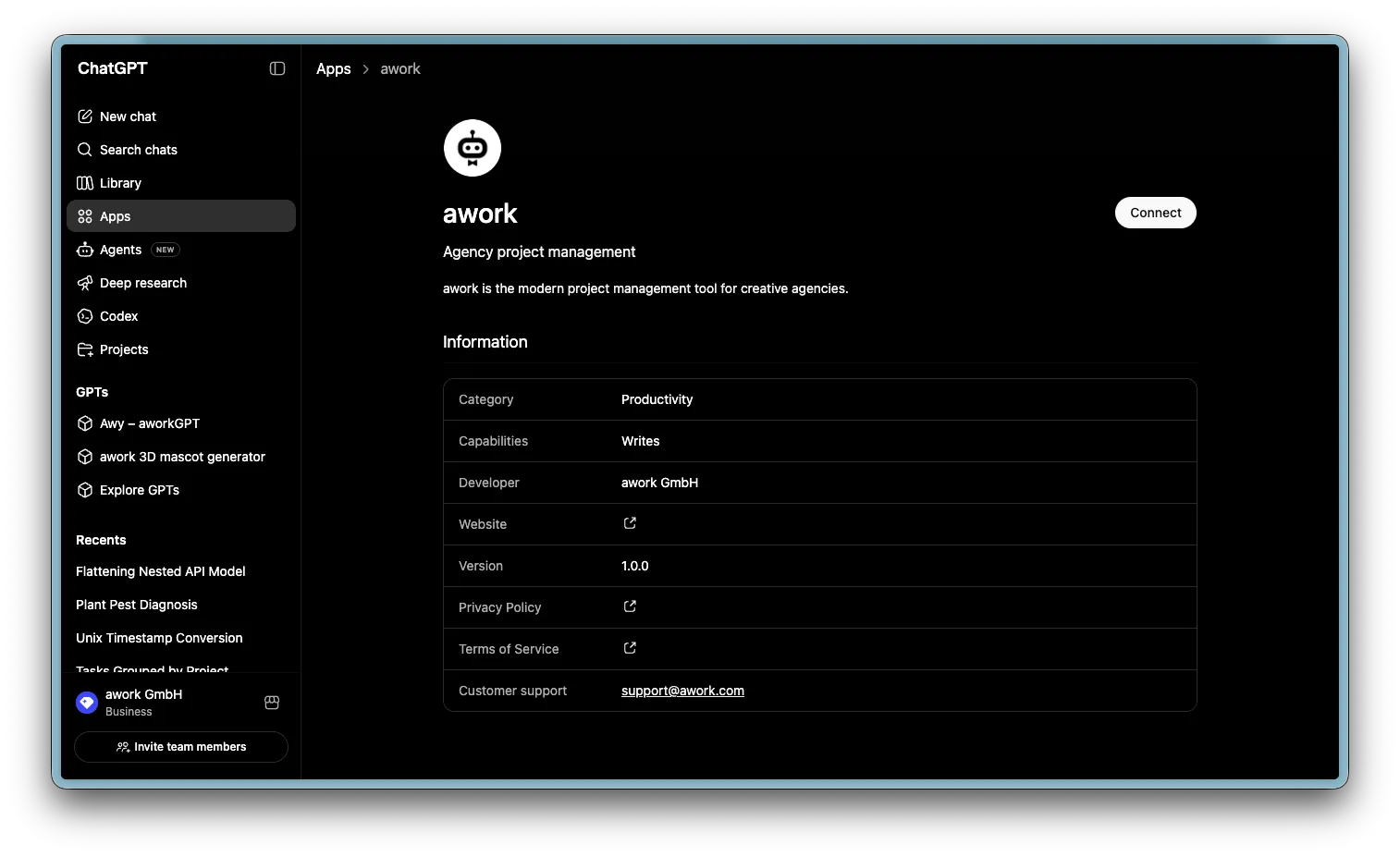
ChatGPT uses Dynamic Client Registration for setup, and you will then be asked to log in with your awork credentials. Find more details here.
Claude Code
In Claude Code, add the MCP server using the following command:
Then launch claude and use the /mcp command, select the awork server, and select Authenticate. You will then be asked to log in with your awork credentials.
Find more details here.
Support
For questions about the MCP server or to report issues:
- Visit the Developer Forum
- Contact support@awork.com
- Refer to the main API documentation for detailed endpoint information
- Find out more about Model Context Protocol (MCP)